
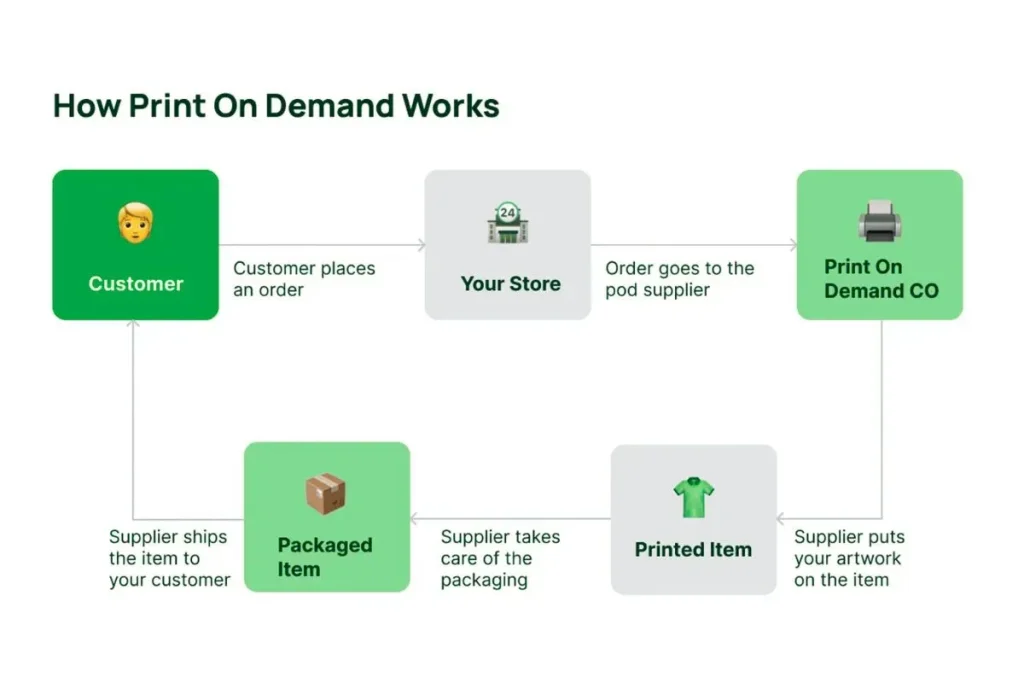
Print on Demand is a flexible fulfillment approach that lets you offer custom products without carrying stock, enabling you to test ideas quickly and reduce risk. In practice, this model can minimize upfront investments and support fast market feedback, helping you start selling with more confidence. Those choosing this route should weigh how the economics compare to a traditional stock-based approach, especially when forecasting demand and cash flow. A robust process for evaluating a stock-heavy versus on-demand approach can reveal where margins improve through leaner production and where delivery timelines may shift. Ultimately, success hinges on a well-defined plan that aligns product strategy, brand goals, and a clear fulfillment workflow for sourcing, printing, and shipping.
From a different angle, the no-stock approach means your items are created only after a customer commits to purchase, a model also described as on-demand production or order-driven manufacturing. This framing helps brands consider potential tradeoffs such as longer production timelines, the variability of print quality, and the importance of reliable partners. Many teams compare such short-run fulfillment strategies to traditional stock by mapping cash flow, lead times, and the ability to scale quickly. A practical path is to pilot a hybrid plan that keeps a core line in stock for speed while testing new designs on demand with trusted fulfillment partners.
1. Print on Demand vs Traditional Inventory: Core Concepts and Trade-offs
Print on Demand (POD) is a fulfillment approach where products are produced only after a customer places an order. You partner with a POD provider who handles printing, packaging, and shipping. This model highlights the print on demand advantages: low upfront costs, minimal inventory risk, and easy experimentation with designs.
Traditional inventory, by contrast, requires buying stock in advance and storing it, which ties up capital and incurs storage and handling costs. The right choice depends on your product mix, branding goals, and growth trajectory. The economics, processes, and strategic implications differ, so selecting the model that aligns with cash flow, speed to market, and brand strategy is essential.
2. Cost, Cash Flow, and Unit Economics: POD vs Inventory Analysis
Upfront investment is a core differentiator: POD demands minimal upfront cash, while traditional inventory ties up capital in stock, freight, and duties. This distinction directly affects working capital and cash flow, as orders convert to revenue without the same level of inventory saturation.
Unit economics vary by model: POD often carries higher per-unit costs due to on-demand production, whereas bulk manufacturing can lower unit costs for best-sellers. Inventory carrying costs—storage, insurance, and handling—erode margins if turnover slows. A careful POD vs inventory analysis helps quantify where margins improve or shrink and informs pricing and marketing decisions.
3. Branding, Packaging, and Quality: How Models Shape Customer Experience
Branding and packaging decisions differ with each model. POD enables rapid design testing and customization, supporting a flexible fulfillment strategy that quickly brings new ideas to market.
Traditional inventory offers full control over packaging, inserts, and premium branding, enhancing unboxing experiences and brand recall. However, POD’s production variability and process limitations can challenge consistency, making sample testing and provider vetting important for maintaining a cohesive brand voice.
4. Speed, Fulfillment, and Reliability: Fulfillment Strategy in Practice
Delivery speed and reliability vary by model. POD fulfillment depends on the provider’s production timelines and shipping network, and orders can sometimes take longer than stock kept in your own warehouse, though automation and expanded networks are shortening these gaps.
Having on-hand stock enables faster dispatch—often same-day or next-day for popular items—boosting customer satisfaction and conversions in markets where speed is critical. A balanced approach uses POD to scale during demand shocks while maintaining traditional inventory for core items, tying into inventory management for e-commerce and a robust fulfillment strategy.
5. When to Use POD, Traditional Inventory, or a Hybrid Approach
POD is advantageous when testing new designs or entering uncertain markets, when the catalog is broad or frequently changing, and when upfront capital is constrained. In these cases, POD vs inventory analysis helps determine whether experimentation should lead or fall back to more traditional stock.
A hybrid approach often delivers the best of both worlds: keeping core best-sellers in traditional stock for speed and margins while using POD for limited editions, seasonal items, or market testing. Evaluate regional shipping speeds and align them with a clear fulfillment strategy to maximize profitability and customer satisfaction.
6. Real-World Scenarios and Actionable Next Steps
Small fashion brands with rotating designs, event merchandise, books, and seasonally driven home decor benefit from POD’s low-risk testing and rapid iteration. When a design proves demand, transitioning it to traditional stock can reduce unit costs and accelerate fulfillment.
To act on these insights, run a POD vs inventory analysis, test samples to verify print quality and packaging, and build a formal fulfillment playbook. Monitor metrics such as gross margin per SKU, days inventory outstanding, order-to-ship times, and customer satisfaction to guide ongoing optimization of your mix.
Frequently Asked Questions
What are the print on demand advantages for small brands?
Print on Demand (POD) offers low upfront costs, minimal inventory risk, and rapid market testing. It enables quick design iterations and scalable experimentation without tying up capital, though per-unit costs can be higher than bulk production.
How do traditional inventory costs compare to the economics of POD?
Traditional inventory requires upfront stock purchases and storage, which ties up cash and incurs carrying costs. POD minimizes cash outlay and storage needs but may have higher unit costs; use a POD vs inventory analysis to assess margins, cash flow, and risk.
What is a POD vs inventory analysis and when should I use POD?
A POD vs inventory analysis weighs cost, cash flow, risk, and speed to market for each model. Use POD when testing designs, managing a broad catalog, or constrained capital; switch to traditional inventory when demand is predictable and scale-ready.
What should I consider in inventory management for e-commerce when using POD?
In inventory management for e-commerce, evaluate POD provider reliability, print/color accuracy, and fulfillment SLAs; ensure real-time stock visibility, smooth returns, and seamless platform integrations to protect margins and customer satisfaction.
How fast is order fulfillment with POD compared to traditional stock, and what affects speed?
POD fulfillment speed depends on the provider’s production and shipping times and can be slower than on-hand stock in a warehouse. Traditional inventory can offer faster dispatch and same/next-day delivery for popular items, influenced by stock levels and logistics.
How can I design a hybrid fulfillment strategy that blends POD and traditional stock?
A hybrid approach uses traditional stock for core best-sellers to maximize speed and margins, while POD handles new designs, limited editions, and testing. Align this with a solid fulfillment strategy and ongoing POD vs inventory analysis to optimize profitability.
| Aspect | Print on Demand (POD) – Key Points | Traditional Inventory – Key Points |
|---|---|---|
| Upfront investment | Minimal upfront cash; no large stock; easy start for budget-sensitive brands. | Requires cash to purchase stock; potential freight/import duties; higher initial commitment. |
| Working capital & cash flow | Improves cash flow; orders convert to revenue without tying up capital in inventory. | Cash tied up in inventory until sale; slower cash conversion especially during slow periods. |
| Unit economics | Higher per-item costs; no bulk discounts; margins can be squeezed on low-priced items. | Bulk manufacturing discounts; potential higher margins on top-selling SKUs. |
| Inventory carrying costs | Negligible carrying costs; items produced on demand. | Storage, insurance, handling; potential obsolescence; ongoing costs. |
| Risk exposure | Minimal risk of unsold stock; risk mainly from production queue or quality variation. | Overstock/obsolescence risk; dependence on forecasting; markdown risk. |
| Branding, product quality, and customer experience | Faster time-to-market and customization; quality depends on provider; packaging varies. | Greater control over branding/packaging; consistent quality; premium unboxing; predictable returns. |
| Speed, fulfillment, and reliability | Fulfillment speed depends on provider; can be slower than on-hand stock; improving automation helps. | Faster dispatch from on-hand stock; potential same-day/next-day fulfillment for stocked items. |
| Scalability | Scales with orders; capacity grows with demand; provider-driven. | Scale via more stock and warehouse capacity; risk of stockouts or overstock during peak times. |
| Inventory management considerations | Focus on provider reliability, print quality, SLAs; less warehousing; real-time stock visibility often external. | Warehouse management, barcoding, perpetual counts, real-time stock visibility; robust internal processes. |
| When to choose | Best for testing designs, broad catalogs, limited upfront capital, flexibility. | Best for high-volume evergreen products, branding control, quick delivery; requires upfront capital. |
| Hybrid approach | Useful to balance cash flow with experimentation; combine POD for new designs with stock for core lines. | Core best-sellers in stock; use POD for experimentation and market testing; regional strategy may vary. |
| Practical use cases & scenarios | Small fashion brand with rotating designs; events merchandise; niche books; trend-driven home decor. | Books with steady demand; established home goods; products with stable SKUs; long-tail items. |
| Tips for making the right choice | Run POD vs inventory analyses; test with samples; build a fulfillment playbook; monitor margins and timing. | Forecast accurately; negotiate with suppliers; optimize storage; align marketing with production windows. |