
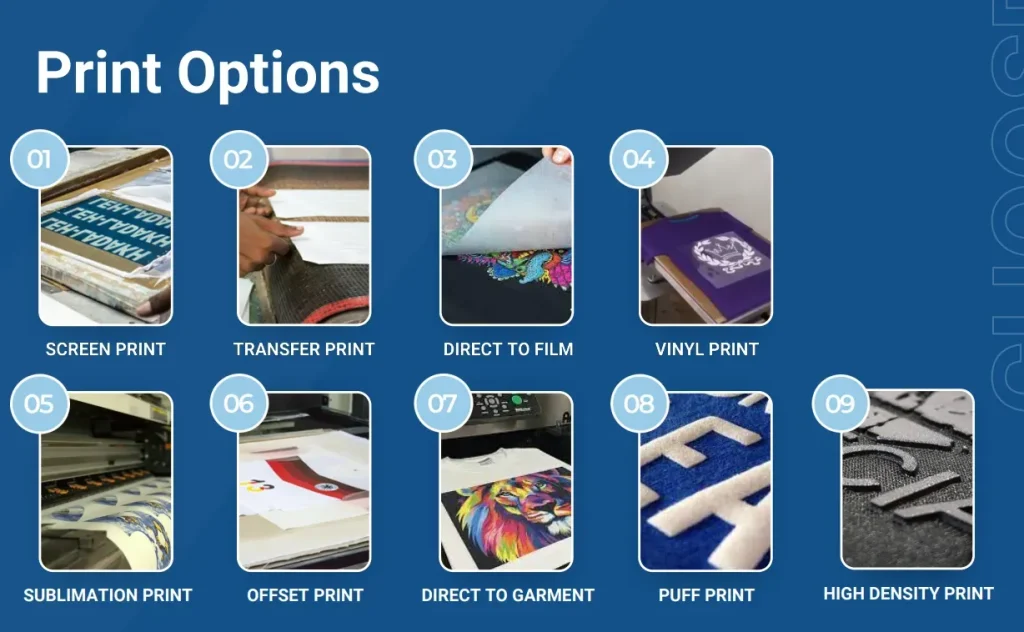
Print methods determine how your designs look, feel, and endure on custom shirts, and understanding options like screen printing helps you balance texture, durability, and cost from the very start, setting expectations for color vibrancy, wash resistance, opacity, edge sharpness, and the overall production timeline you’ll promise to teammates, clients, or class groups, while also giving you a framework to compare ink chemistry, substrate compatibility, and sustainability considerations across different fabrics, and a shared commitment to responsible manufacturing practices that protect people and the planet.
DTG printing delivers high-resolution detail and a soft hand, especially for on-demand orders and artwork with gradients, because digital ink sits directly on the fabric and allows rapid design changes without retooling, while pre-treatment choices, ink chemistry, and curing temperatures influence vibrancy, washfastness, and how the resulting image feels to the touch, with some setups prioritizing speed to market while others emphasize color fidelity and archival quality, and this versatility also means teams can experiment with limited editions and rapidly adjust campaigns based on what resonates with buyers.
Screen-based production remains a workhorse for bold, opaque colors and long-lasting performance when a project calls for multiple colors or extended wear in demanding conditions, since the layered ink approach tends to resist fading and cracking after repeated laundering, and savvy operators optimize stencil alignment to ensure consistent registration across dozens or thousands of pieces, even under tight production schedules, while designers benefit from seeing how the final result translates across different garment cuts and sizes.
For teams facing a mix of order sizes, deadlines, and fabric types, a practical decision hinges on whether you need speed and flexibility over the per-unit efficiency of traditional setups, or whether you can leverage the economies of scale, color accuracy, and durability that come with longer lead times and larger runs, with clear criteria for when to ship, restock, or revise designs.
By weighing your design complexity, audience expectations, supply chain realities, and budget against the strengths and trade-offs of these primary print methods, you can choose a path that delivers compelling visuals, reliable durability, and a sustainable balance between quality and cost for your project, helping you build trust with customers and stakeholders over time, and creating a repeatable process that supports growth.
Print Methods for Custom Shirts: Screen Printing, DTG, and Heat Transfer
Understanding the print methods available for custom shirts helps you predict how your designs will look, feel, and wear over time. By considering screen printing, DTG printing, and heat transfer, you can choose approaches that align with your budget, timeline, and sustainability goals while delivering high-quality results for your customers.
This overview introduces the three most popular methods—screen printing, DTG printing, and heat transfer—and explains how each method works in practice. You’ll learn where each shines, how setup and tooling impact cost, and practical tips to minimize waste and maximize durability for your project, whether you’re creating custom shirts for a school club, a fashion line, or a corporate event.
Screen Printing Deep Dive: Bold Colors, Durability, and Efficiency for Large Runs
Screen printing uses a separate stencil (screen) for each color in a design. Ink is pushed through these screens with a squeegee, building up color layer by layer to create a final image. This method is highly scalable and tends to excel on larger orders with simple, bold artwork.
Key considerations include choosing between plastisol and water-based inks, setting up accurate color alignment, and curing the ink to lock in durability. For custom shirts produced in volume, screen printing offers strong color vibrancy, excellent opacity on light and dark fabrics, and a lower per-unit cost as quantities rise.
DTG Printing for High-Detail Designs on Custom Shirts
Direct-to-garment (DTG) printing deposits water-based inks directly onto fabric using an inkjet-style process. This yields high-resolution detail, subtle gradients, and photo-like quality that is difficult to achieve with traditional screen printing.
DTG shines for on-demand orders, small runs, and designs with complex artwork. The hand feel is often softer because the ink absorbs into the fabric. However, costs can rise with volume, and achieving vibrant colors on dark shirts may require pretreatment and additional curing steps.
Heat Transfer: Versatility and Quick Turnarounds for Small Batches
Heat transfer encompasses printed transfers, vinyl (HTV), and other transfer methods applied to fabric using heat and pressure. Transfers are created on a separate surface and then fused to the garment, offering flexibility for multi-color artwork and specialty finishes.
This approach is particularly well-suited for small runs, personalization (names and numbers), and projects needing fast turnaround. While transfers provide design flexibility and compatibility with many fabrics, performance can vary by transfer type, and the long-term durability may depend on proper application and washing practices.
Screen Printing vs DTG: A Practical Comparison for Custom Shirts
When deciding between screen printing and DTG for custom shirts, consider order quantity, design complexity, and fabric. Screen printing is typically more cost-efficient for multi-color designs in larger runs and works well on cotton-rich fabrics, while DTG is ideal for small runs, photo-quality art, and frequent design updates.
Color management, registration precision, and pretreatment requirements also influence the choice. If your design relies on bold, opaque colors with high durability at scale, screen printing vs DTG often favors the former; for intricate details and on-demand accessories, DTG provides versatility that screen printing cannot easily match.
Practical Tips for Selecting Print Methods and Maximizing Longevity
To pick the right method for your custom shirts, map your goals: line launch, one-off order, or ongoing collection. Assess order size, frequency, design intricacy, and fabric type, then align these factors with screen printing, DTG printing, or heat transfer for optimal cost, speed, and quality.
Carefully plan production with a small test print or sample to evaluate finish, hand, and durability before committing to a large run. Consider long-term maintenance, wash cycles, and potential sustainability impacts—screen printing, DTG, and heat transfer each have different implications for waste, water use, and ink consumption that can affect your bottom line and environmental footprint.
Frequently Asked Questions
What is screen printing and when is it the best option for custom shirts?
Screen printing is a time-tested method where each color in a design uses its own screen, ink is pushed through with a squeegee, and multiple layers are cured. It’s best for custom shirts with bold, opaque colors and logos and becomes highly cost-efficient for larger runs on cotton or cotton-blend fabrics. Proper curing and setup yield durable, vibrant results that withstand frequent washing.
How does DTG printing compare to screen printing in terms of detail, hand feel, and suitability for custom shirts?
DTG printing deposits water-based inks directly onto fabric, producing high-resolution detail, gradients, and a very soft hand—ideal for small runs and on-demand orders. For large quantities, per-unit costs are usually higher than screen printing, but no screens are required and edits are easy. Durability is strong with proper pretreatment and curing on 100% cotton or blends.
What are the main differences between heat transfer and screen printing for custom shirts, and when should you choose heat transfer?
Heat transfer covers designs applied with heat and pressure, offering quick setup and broad design flexibility for small runs or personalized shirts. It supports many finishes (glitter, metallics) and works on a wide range of fabrics. Durability varies by transfer type, and large runs can be more costly per shirt than screen printing.
Can you mix print methods on a single order of custom shirts, and what should you consider?
Yes, you can combine methods (for example, screen printed logos with DTG artwork or transfers for personalization), but consider fabric compatibility, color matching, wash durability, and total lead time. Mixing methods can optimize for cost, finish, and speed, but it adds setup complexity.
When deciding among screen printing, DTG printing, and heat transfer for a small-batch order of custom shirts, what factors matter?
Key factors include order size, design complexity (colors and gradients), fabric type, desired hand feel, durability expectations, and budget or timeline. For tiny runs or on-demand designs, DTG or heat transfer may be faster; for simple logos with solid colors, screen printing can still be cost-effective.
How should I care for shirts printed with screen printing, DTG printing, or heat transfer to maximize longevity?
Follow garment care labels and wash inside out. Screen-printed designs cure well and resist fading with proper heat and compatible fabrics; DTG prints require correct curing and careful washing to maintain color and detail; heat transfer results vary by transfer type, so follow specific care instructions. A sample or test print helps verify durability before a full run.
| Method | How it works | Pros | Cons | Best use cases |
|---|---|---|---|---|
| Screen Printing |
|
|
|
|
| DTG Printing |
|
|
|
|
| Heat Transfer |
|
|
|
|
Summary
The table above highlights the core differences and practical considerations for the three main print methods used for custom shirts. Screen printing excels in durability and cost efficiency at scale for bold, simple designs on cotton blends. DTG prints deliver exceptional detail and soft hand for small runs or complex artwork, with flexibility for quick design changes. Heat transfer offers versatile, on-demand capabilities with support for specialty finishes and personalization, though durability and cost can vary with the type. Use these insights to match your design, quantity, and fabric with the most suitable method.